Defying Gravity Art

Liam Reilly
| 17-06-2026
 · Art Team
Think of a bronze figure several times human scale, leaning at an extreme angle yet balanced on a base that appears unexpectedly small.
The instinct is to assume it should collapse, yet it remains in complete stability. This is not illusion; it is the result of precise structural engineering applied to art.
While viewers often focus on the surface of a sculpture—the polished bronze or carved stone—the real complexity lies beneath it. Monumental sculpture requires a careful integration of aesthetics and physics, where every form must also function as a stable structure under gravity and environmental forces.
The Armature: The Invisible Spine
The stability of large sculptural forms depends on an internal support system known as an armature. This framework is typically constructed from reinforced metal components that define the internal geometry of the work before any external material is applied.
In large bronze sculptures, this internal structure distributes weight and resists deformation. Each joint and connection must be engineered to handle long-term load stress, ensuring the final form remains stable after casting and installation.
Without this internal framework, heavy sculptural materials would gradually deform under their own weight, especially in extended or cantilevered forms.
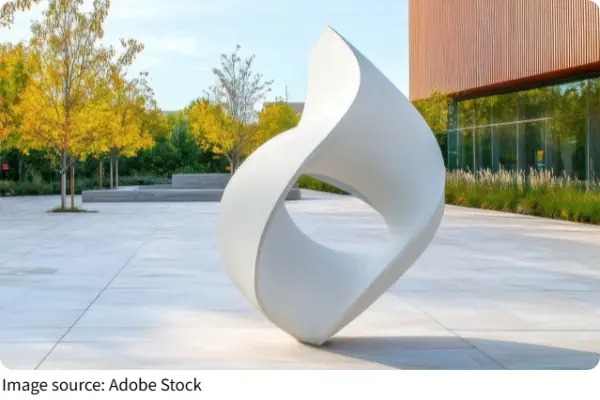
The Physics of Stability
A sculpture remains upright when its center of gravity stays within its base of support. When artists design dynamic or leaning forms, they deliberately position mass in a way that keeps this balance within safe limits.
This requires careful control of proportions, thickness, and internal mass distribution. Even visually unstable compositions are engineered so that gravitational forces are continuously redirected through the structure into the foundation.
Engineering Methods of Balance
Base Anchoring:
Large outdoor sculptures are secured to deep foundational systems that extend below ground level, ensuring resistance to wind, vibration, and shifting soil conditions.
Hollow Construction:
Many metal sculptures are cast as hollow forms. This reduces overall weight while allowing controlled redistribution of mass, often concentrating weight toward the lower sections.
Internal Weight Distribution:
Strategically placed internal masses may be used to counterbalance extended or asymmetrical forms, improving overall stability.
Structural Geometry:
Even abstract designs rely on hidden geometric principles such as triangular load distribution, which helps transfer forces efficiently through the structure.
The Process of Construction
In stone sculpture, stability is determined entirely by material removal. Unlike metal structures, stone cannot be adjusted after carving, making precision essential throughout the process.
Scaled models and measurement transfer systems are used to replicate proportions accurately from small studies to full-scale works. Each reduction of material permanently alters structural balance, requiring careful planning at every stage of creation.
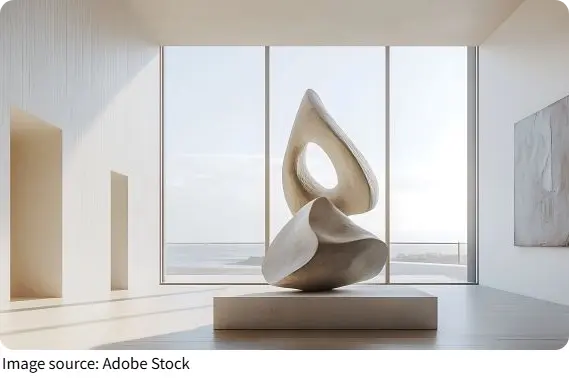
Balance as a Design Principle
Monumental sculpture demonstrates that stability is not the absence of movement, but the controlled management of forces. Every leaning form, extended structure, or suspended element is supported by an invisible system of calculated balance.
This principle reflects a broader design truth: lasting structures—whether physical or conceptual—depend on internal organization rather than external appearance. What appears effortless is, in reality, the result of precise engineering, disciplined planning, and structural intelligence.